Why Leasing AI Data Never Reaches Your Warehouse
A first-person account of where AI leasing conversation data lands, and why an API, a CSV export, and paid read access each stop short of solving it.

Remen Okoruwa · Co-Founder & CEO, Propexo
7 min read
The rollout goes fine. Leads get answered at two in the morning, tours get booked while the office is closed, and the leasing team stops drowning in repetitive email. Three months in, somebody from the asset management side asks the question that derails the quarterly review: can we get the conversation data into our warehouse, next to the rest of the portfolio? The vendor is happy to help, and the help arrives as a quote. A custom integration, roughly six weeks of work, built one-off for your stack, and owned by whoever built it when the API changes and it quietly stops delivering rows.
Every operator running an AI leasing assistant eventually asks that same question, because these platforms sit on the richest seam of operational data a leasing funnel produces. And nearly every operator gets some version of that same quote back. One custom integration is an annoyance. Multiplied across a portfolio and a dozen tools, each with its own version of the six weeks, it becomes the reason sophisticated operators still cannot answer basic questions about their own leasing pipeline. None of that is an artificial intelligence problem. It is a plumbing problem wearing an AI costume, and the industry keeps trying to solve it with better AI instead of better plumbing.
The Data an AI Leaves Behind
Start with what makes this specific category worth the fight. An AI leasing platform is only as good as the data it can reach, which operators mostly understand by now, and as good as the data it leaves behind, which almost nobody prices in at purchase time. Every conversation the assistant handles is operational exhaust with real value in it: which floor plans prospects ask about and never tour, which objections kill deals at the pricing stage, how long leads sit before they ghost, what people are told about concessions. That is funnel intelligence a revenue manager would pay for, sitting in a vendor’s database, reachable only through the vendor’s own reporting screens.
What that means in practice: an operator can hold three years of leasing conversations across its portfolio and still be unable to answer why conversion dropped at its Class B communities last spring, because the conversations live in one system, the pricing history in another, and the availability data in a third. The analysis is not hard. Getting the three tables into the same place is what is hard, and it is the step the industry keeps deferring.
The counterargument deserves a fair hearing, because the vendors are not villains here. These platforms are genuinely good at what they sell, and they ship dashboards of their own, which for a single community may be enough. A vendor’s job is to make its own product complete, not to underwrite your portfolio data strategy. The gap appears at the portfolio level, where the questions worth asking cut across systems: leasing conversations joined to unit availability, pricing history, renewal outcomes, and maintenance load. No vendor dashboard answers cross-system questions, because no vendor holds the other systems’ data. Only your own warehouse can, and only if the data arrives there.
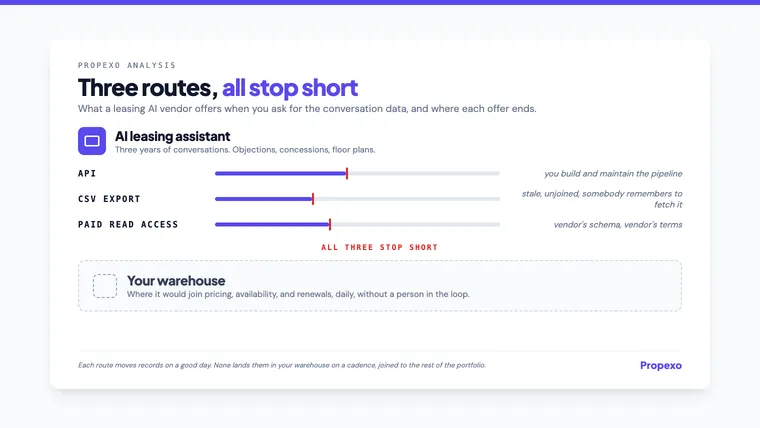
The vendor’s other answer deserves the same fair hearing, because it is the one every operator will hear first: we have an API, there is always a CSV export, and some vendors will even sell read access to the database that holds your data. All of it is true, and none of it is the thing. An API is a door, not a delivery. Someone still has to build the pipeline through it, keep it standing when the API changes, and reconcile its output against two other systems’ idea of the same lead, which is the six-week quote wearing different clothes. A CSV export produces a snapshot, pulled by hand on whatever schedule a busy team keeps, so the data arrives stale and unjoined. Paid read access is the most honest of the three offers, and notice what it concedes: you are renting a window into your own operational record, in the vendor’s schema, on the vendor’s terms. The question was never whether the data can leave the vendor’s system on a good day. It is whether it lands in your warehouse every day, in a shape your other tables recognize, without anyone remembering to go get it.
The lifecycle of the alternative compresses into one line: a custom one-off integration feels fine until you have a portfolio, a dozen tools, and APIs that keep changing. That is the part the six-week quote never includes. The build is an event, but the maintenance is a subscription paid in engineering attention, and it comes due at the worst times, whenever a vendor ships a breaking change on its own schedule. Operators who have lived this describe the same arc: the integration works at launch, drifts as the API evolves, and fails silently until a quarter-end report comes back wrong.
The Question to Ask Before the Next Renewal
An operator who wants to know how exposed they are does not need a consultant, just an honest hour with their own stack. Take the AI leasing tool, the CRM, the screening platform, and whatever else touches a lead before move-in, and for each one ask what happens to the data if the contract ends next month. Whether anyone on your team can run a query against last quarter’s leasing conversations today, without filing a ticket with a vendor, is a second revealing test. And if the answer to either question depends on a person who left the company or an integration nobody has touched since it was built, that is the honest read on where the portfolio stands. Most operators who run this exercise find they own their rent roll and rent their funnel.
The uncomfortable part of the audit is realizing the exposure compounds at renewal time. A vendor who holds three years of your leasing conversations holds leverage no procurement team would knowingly grant, because switching now means abandoning the history. The obvious rejoinder, that an operator unhappy with the quote can always switch to a rival AI leasing vendor, proves the point rather than answering it. Switching is exactly the moment the data question stops being theoretical, because the conversation history does not transfer with the contract. Whichever assistant wins the head-to-head, the record of what your prospects said stays behind with the loser unless it was landing in your warehouse all along. Data egress negotiated at signing costs almost nothing. The same egress negotiated at renewal is priced like the hostage it is.
Plumbing as a Category, Not a Project
What changes the economics is treating extraction as a product instead of a project. Other industries already ran this experiment. Nobody in mainstream data infrastructure writes a one-off Salesforce sync anymore, because managed connectors turned that work into a category: built once, maintained centrally against API changes, delivering normalized data into whatever warehouse the customer owns. When one customer’s connector breaks, the fix ships to every customer, which is the entire difference between a product and six weeks of custom work.
Extraction is only half of that product, and it is the easier half. What remains is the unglamorous work of making one tool’s “prospect” line up with another tool’s “guest card” and a third tool’s “lead” so a query can join across them without a translation layer built by hand. The industry’s word for that work is normalization. An operator experiencing its absence has a simpler description: the data is still locked in, just in a different building. Every custom integration re-solves that mapping privately and imperfectly, and the mapping rots as each vendor evolves its schema. Done as a product, the mapping is solved once, argued about once, and maintained in one place, which is the part of the category that compounds. The pipes move the data. The shared schema is what makes the data worth moving. Integrations as a service is a new category, and the need it answers is anything but new. The need is a decade old. The category treating it as standard product is what is new for multifamily.
That is the context for the category Propexo builds in: standardized integrations for AI leasing platforms, alongside its RentCafe, Knock, and Funnel CRM connectors, on the same framework. The specifics matter less than the shape. Leasing conversation data flows into the warehouse the operator owns, normalized against the same schema as the rest of the stack, maintained as a product rather than commissioned as a project. The AI keeps doing what it is good at, and the data it generates stops being a captive of the tool that generated it.
The Procurement Rule That Fixes This
The directive is aimed at whoever signs technology contracts. Make data egress a gate in every AI and proptech purchase, not a nice-to-have: before the demo impresses anyone, ask where the operational data lands, in what format, on what cadence, and what it costs to keep that flowing after year one. Score the six-week custom quote honestly by adding the maintenance it omits, then compare it against a standardized connector where one exists for the tool. Budget integration upkeep as a line item the way you budget unit turns, because both are recurring costs that get expensive precisely when deferred. And for the tools already deployed, negotiate egress at the next renewal while you still have alternatives, not after the history is too valuable to walk away from.
The AI wave in multifamily will sort operators into two groups, and the sorting has little to do with which assistant they picked. One group will own a compounding record of everything its funnel learned, queryable next to its operational history. The other will have rented some conversations for a few years and kept none of what they taught. What separates the two is plumbing, decided quietly, one procurement decision at a time.
Frequently asked questions
- Why can't I get my AI leasing assistant's conversation data into my data warehouse?
- Usually you can, but not in a form that is useful without ongoing work. Most vendors will offer an API, a CSV export, or paid read access to the database holding your data. Each moves records out on a good day; none of them lands data in your warehouse on a daily cadence, normalized so it joins to your pricing, availability, and renewal tables. Closing that gap is either a custom integration you build and maintain, or a managed connector maintained as a product against the vendor's API changes.
- Is a custom integration to a leasing AI platform worth it?
- Score it honestly before deciding. The typical quote covers roughly six weeks of build, and the build is the cheap part. The recurring cost is maintenance: the integration works at launch, drifts as the vendor evolves its API, and often fails silently until a quarter-end report comes back wrong. Multiply that across a portfolio and a dozen tools and the maintenance, not the build, is what makes the approach expensive.
- What questions can't a vendor dashboard answer?
- Anything that cuts across systems. A vendor dashboard can report on the data that vendor holds, which is why it may be entirely sufficient for a single community. It cannot join leasing conversations to unit availability, pricing history, renewal outcomes, and maintenance load, because no vendor holds the other systems' data. Portfolio-level questions live between systems, so they can only be answered where all the systems land, which is a warehouse the operator controls.
- What does data egress mean in a proptech contract, and when should I negotiate it?
- Data egress is your right to get your own operational data out of a vendor's system, in what format, on what cadence, and at what cost after year one. Negotiate it at signing, when you still have alternatives and the vendor is competing for the business. Negotiating it at renewal inverts the leverage: by then the vendor holds years of history that does not transfer with the contract, and the price reflects that.
- Does switching AI leasing vendors solve the data problem?
- No, and it is the moment the problem stops being theoretical. Conversation history does not transfer with the contract, so whichever assistant wins the head-to-head, the record of what your prospects said stays behind with the loser unless it was landing in your own warehouse all along. Switching changes which vendor holds your funnel data; it does not put you in possession of it.
Written by
Remen Okoruwa
Co-Founder & CEO, Propexo
Remen is co-founder and CEO of Propexo. A former McKinsey consultant and HubSpot Senior PM, he is a Harvard graduate and has passed all three levels of the CFA exam. He writes about the data infrastructure layer multifamily operators need before analytics or AI projects can ship.
Keep reading
AI readiness
Your Pipelines Are Landing Data. Your AI Still Can't Answer the Question.
Multifamily operators have solved data movement, not the layer above it. What matters now is a shared definition of what the data means.
8 min read
Property data integration
Your Market Data Is Unified. Your Operating Data Is Not.
A read of the 2026 CRE data-platform rankings: they rank the third-party market data you license and skip the first-party operating data you own.
8 min read
Multifamily analytics & BI
The Biggest Operators Did Not Pick a PMS. They Picked a Warehouse.
Why portfolios above 15,000 units run several property management systems at once, and what that does to the question of which one to buy
6 min read