How to Evaluate Property Management Software
A 2026 buyer guide to the criteria that decide whether a PMS works out after you sign, including what data extraction costs and how to negotiate it.
7 min read Updated
On this page
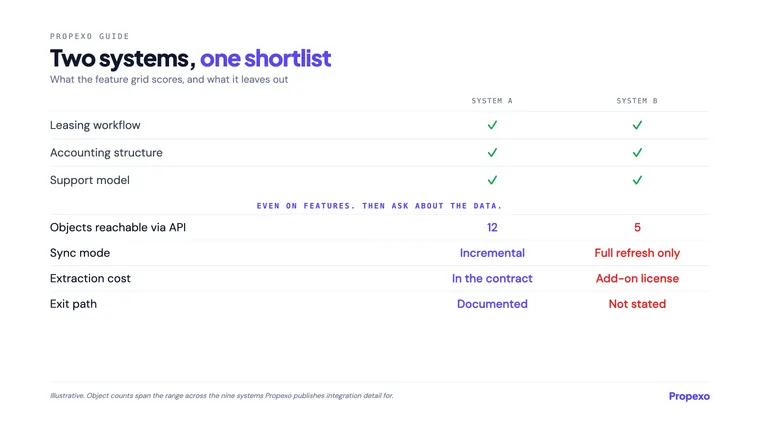
Most property management software evaluations compare features, price and support, score the results, and pick a winner. That process is not wrong, and it is not sufficient. By the shortlist stage most enterprise systems do most things, so the feature grid stops discriminating at exactly the moment you need it to.
The criteria that decide whether you are happy two years in are usually the ones nobody scored: what data you can get out, how often, what that costs, and what leaving would cost.
What do most evaluations get right?
The operational fit questions, and these genuinely matter. Does the system handle your unit types and your accounting structure. Does its leasing workflow match how your teams actually work rather than how a process document says they do. Does it hold up at your portfolio scale. Is the support model real.
Get these wrong and nothing else matters. They are also the questions vendors are ready for, which is why every shortlist ends up looking similar.
What do they usually miss?
Five things, all of them about what happens after the contract is signed.
Which data can you actually extract? Not “does it have an API”, which is close to universally yes now, but which objects that API exposes. If prospects, work orders or ledger transactions are not reachable, no reporting project recovers them later and somebody ends up maintaining a manual export forever. Ask for the documentation during evaluation and read it.
How often can you extract it? Systems that support incremental extraction move only what changed. Systems that only support full refresh re-read everything on every run, which at portfolio scale sets a hard ceiling on how often you can afford to sync. That ceiling becomes your reporting freshness, and it is very hard to argue with after the fact.
How do you authenticate, and who holds the credential? Static API keys, license keys and username-and-password integrations all work, and they carry different security and rotation burdens. This is a five-minute conversation during evaluation and an awkward one during a security review eighteen months later.
What does extraction cost? Getting your own data out is usually a priced capability rather than an included one, and the price hides in several places at once. Ask for the whole number during evaluation, because it is the line item most likely to be missing from your comparison.
What does leaving cost? Every buyer plans to stay. Ask anyway: in what format does your data come back, how complete is it, and how long does it take. The answer tells you how much leverage you will have at every renewal.
Why is data access the under-weighted criterion?
Because its cost is deferred and its benefit is invisible at the time.
An evaluation happens under time pressure, run by people who need the system to work for leasing, accounting and maintenance on day one. Data access does not affect day one at all. It affects the board reporting project in year two, the BI rollout in year three, and every AI initiative after that, by which point the decision is long made and the constraint is simply a fact of life.
This is also the dimension where the differences between systems are largest. Across the nine property management systems we publish integration detail for, the number of object types reachable ranges from five to twelve, some support incremental extraction and one does not, and none of them uses a modern delegated authentication flow. A shortlist that looks even on features is frequently not even on data.
What does data extraction actually cost?
More than most evaluation spreadsheets record, because the cost is spread across four places that are each individually easy to miss.
Licensed add-on products. The modern egress paths at the largest vendors are separate products with their own names, their own product pages and their own licensing, rather than capabilities included with the platform. That is a defensible way to package engineering work, and it also means “the system has an API” and “we can get our data out affordably” are two different findings.
A required hosting tier. Some egress options are only available on a particular deployment model, so the quoted price of the option is not the whole cost of reaching it. Yardi Replicate, for example, works from the Voyager private cloud, which makes the hosting model a prerequisite rather than a detail.
Per-integration and certification fees. Where a vendor charges a third party to certify or maintain an integration, that cost does not disappear. It arrives in your integrator’s pricing instead.
Usage-based API pricing. Where calls, records or syncs are metered, your reporting freshness has a marginal cost. That is the version of this problem that quietly caps how often you refresh anything.
None of these is unreasonable in isolation. The problem is that they are usually discovered sequentially, after signing, by whoever inherited the reporting project.
Can you negotiate free data extraction?
Frequently yes, and this is the part worth acting on: your leverage over the price of your own data is at its maximum before you sign, and it never returns to that level again.
During a competitive evaluation the vendor is trying to win. Data access is one of the cheaper things they can concede, because it costs them far less than an equivalent discount on license fees, and it is often within a salesperson’s discretion when a percentage off is not. After signing, the same request is a change order against a vendor with no competitor in the room.
Concrete asks, in rough order of how often they succeed:
- API and extraction access included for the contract term at no incremental charge.
- No per-call, per-record or per-integration fees, or a cap if metering cannot be removed.
- The freedom to appoint a third-party integrator without a certification or partner fee.
- If an egress product is genuinely separately licensed, the price locked for the term with a defined renewal ceiling, so the capability you built on cannot be repriced once you depend on it.
- A documented exit path: format, completeness and a stated number of days, written into the agreement rather than described in a meeting.
Two practical notes. Get it in the order form or the agreement, not in email, because product packaging is reorganized and account teams change. And treat the response itself as evidence: a vendor who will confirm data access terms in writing is telling you something about the next five years, and so is a vendor who will not.
A short evaluation checklist
Bring these to the demo, alongside whatever your feature grid already covers.
- Which objects are exposed through the API, and can we see the documentation today.
- Does extraction support incremental sync, or full refresh only.
- How do we authenticate, and can the credential be scoped to read-only.
- What does extraction cost in total: add-on licenses, hosting prerequisites, per-integration fees, metered usage.
- Will you include extraction access at no incremental charge for the term, in the order form.
- Which of the systems we already run are supported, and by whom.
- What is the exit path for our data: format, completeness, timeline.
- Run the demo on our data, including the edge cases we know are messy.
That last one matters more than it sounds. Vendor demo environments are built to look clean, which means they are built to avoid exactly the situations that will cause you trouble: the mid-month renewal, the unit off-line for renovation, the property that changed management companies halfway through a year.
What is the best property management software?
There is no single best one, and the shape of the market is why. Our residential proptech market map counts 49 property management systems, of which only 6 are built for enterprise portfolios. The 2026 unit counts put the top four (MRI Software, Yardi, AppFolio, RealPage) inside a 2x spread with no vendor near a majority. A market with no dominant system is a market where “best” depends on who is asking.
What that means in practice: at the shortlist stage the enterprise systems do most of the same things, so the question that discriminates is the one this guide keeps returning to. Which objects can you extract, how often, at what cost, and what does leaving cost. Two systems that look even on a feature grid are frequently not even on that dimension, and it is the dimension that outlasts every other line on the scorecard.
For portfolios above roughly 15,000 units there is a further wrinkle. Operators that got there by acquiring other management companies usually inherit two or three systems and keep running them, because a PMS migration across a portfolio that size is a multi-year project with its own risk. The practical question stops being which system to standardize on and becomes how to report across all of them, which is a warehouse question. The how-to on landing Yardi, RealPage, and Entrata in one warehouse covers the mechanics.
Why there is no ranking here
Propexo builds integrations with these systems. A “best PMS” ranking from us would carry an obvious conflict and would not be worth reading, so we have not written one.
What we can speak to honestly is the integration and data-access dimension, because we work with these platforms in production every day. That happens to be the part of the evaluation almost everyone under-weights, and it is the part that outlasts every other line on the scorecard.
If you want the vendor-by-vendor detail on that dimension, it is published separately on this blog, with the source of every figure stated.
Frequently asked questions
- What should you look for in property management software?
- Start with the operational fit: does it handle your unit types, your accounting structure, your leasing workflow and your portfolio scale without heavy customisation. Then check the things most evaluations skip, because they are what decides satisfaction later: which data you can extract and how often, whether the integration surface covers the systems you already run, what implementation genuinely requires from your team, and what it would cost to leave. Features converge across the shortlist. Data access and exit cost do not.
- What questions should I ask a PMS vendor about integrations?
- Five, and ask them during evaluation rather than after signing. Which objects are available through your API, and can I see the documentation now. Does extraction support incremental sync or only full refresh. How do we authenticate, and can that credential be scoped to read-only. What does extraction cost, including any add-on products, hosting requirements or per-integration fees. What happens to our data if we leave, in what format, and how long does that take. A vendor who answers these quickly and specifically is a good sign in itself.
- Do property management systems charge for API access and data extraction?
- Often, and the charge is rarely a single line item. It can appear as a licensed add-on product for the modern egress paths, a required hosting tier before a given option is even available to you, a per-integration or certification fee charged to the third party and passed back to you, or usage-based pricing on the API itself. None of that is unreasonable on its own, but it is frequently absent from the evaluation spreadsheet, so the total cost of getting your own data out only becomes visible in year two. Ask for the full breakdown in writing during the evaluation.
- Can you negotiate free data extraction into a PMS contract?
- Frequently yes, and the window is before you sign. During a competitive deal the vendor is trying to win, and data access costs them far less to concede than a discount on license fees, so it is one of the cheaper asks you can make. The asks worth making: API and extraction access included for the term at no incremental charge, no per-call or per-integration fees, the freedom to use a third-party integrator without a certification charge, a documented exit format and timeline, and renewal protection so extraction cannot be repriced once you depend on it. Get it into the order form or the agreement rather than accepting a verbal assurance, because product packaging changes and a salesperson moves on.
- Is the biggest property management system the best one?
- No, and size is a poor proxy for fit. Unit counts measure footprint, not suitability for your portfolio, and the largest systems tend to be the most configurable, which is another way of saying they require the most configuration. What matters is whether the system fits how you actually operate and whether you can get your data back out. A smaller system that matches your workflow and has a clean API can be a much better outcome than a market leader you spend two years bending into shape.
- What is the best property management software for multifamily?
- There is no single best one, and any page that names one without asking about your portfolio is selling something. The enterprise tier is small: our residential proptech market map counts 49 property management systems and only 6 built for enterprise portfolios, and the top four by units (MRI Software, Yardi, AppFolio, RealPage) sit inside a 2x spread with no majority holder. What separates them for a given operator is operational fit, and then the dimension this guide is about: what data you can get out, how often, at what cost, and what leaving costs. Score those and the answer usually stops being a ranking and becomes a shortlist of two.
- What property management software should I use if I manage over 15,000 units?
- At that scale you are choosing among the enterprise platforms, and often you are not choosing at all: operators that reached 15,000 units by acquiring other management companies typically inherit two or three systems and run them side by side. The evaluation question shifts from which one to how you report across all of them, which is a data-access question rather than a features question. Weight extraction, sync frequency and exit cost heavily, ask for the integration documentation before you sign, and plan for a warehouse that holds every system you run rather than a migration onto one.
- Why does this guide not rank the vendors?
- Because Propexo builds integrations with these systems, which means a ranking from us would carry an obvious conflict and would not be worth reading. What we can speak to honestly is the integration and data-access dimension, where we work with these platforms in production every day. That is the part of the evaluation almost everyone under-weights, and it is the part where we have something to say that a generic buyer guide does not.
Written by
Propexo Team
Written by the Propexo team — the people building the integration layer between property management systems and the tools that need their data. Propexo connects platforms like Yardi, RealPage, and Entrata to warehouses and proptech applications.
Keep reading
PMS platforms
Property management system unit counts, 2026
How many units run on each major property management system in 2026 — MRI 15.6M, Yardi 15M, AppFolio 9.5M, RealPage 9M — with every source documented.
7 min read
Property data integration
Your Market Data Is Unified. Your Operating Data Is Not.
A read of the 2026 CRE data-platform rankings: they rank the third-party market data you license and skip the first-party operating data you own.
8 min read
Multifamily analytics & BI
The Biggest Operators Did Not Pick a PMS. They Picked a Warehouse.
Why portfolios above 15,000 units run several property management systems at once, and what that does to the question of which one to buy
6 min read