Why PMS Integrations Don't Fix Your Data Strategy
A response to Thesis Driven's PMS openness survey: integration and data ownership are different problems, and AI pilots are exposing the gap.

Remen Okoruwa · Co-Founder & CEO, Propexo
5 min read
On this page
- Why does a “connected” PMS still leave you data-blind?
- The four ways data leaves a PMS, and why each one stops short
- Why fragmentation is the real problem, not integration quality
- Why AI pilots are the moment this gap stops being theoretical
- What a real data strategy actually requires
- Where Propexo fits in that stack
This piece was originally published by Thesis Driven as Your PMS Integrations Are Working. Your Data Strategy Isn’t. It’s one of the clearest statements we’ve seen of a problem we work on every day, so rather than reproduce it, we wanted to build on it from where we sit: inside the pipes connecting property management systems to the tools that need their data.
The core claim holds up from where we sit: multifamily operators have spent years and real budget getting their systems talking to each other, and a surprising number of them still can’t answer a simple portfolio-wide question without a manual export and a weekend in a spreadsheet. That’s not a failure of effort. It’s a sign that “integrated” and “usable” are being treated as the same milestone when they’re two different ones.
Why does a “connected” PMS still leave you data-blind?
Because connecting to a system and structuring what comes out of it are separate jobs, and most integration work only does the first one. Yardi, RealPage, Entrata, and AppFolio have each made real improvements to their APIs over the past few years — better documentation, more endpoints, faster rate limits. None of that changes what shape the data arrives in, or whether it agrees with the other five tools an operator also runs.
Recent survey work on PMS platform openness (the kind Thesis Driven has been running) tends to land every major vendor in a similar middling band — genuine progress, but nowhere near “solved.” That’s consistent with what we see in the field: the ceiling on any single vendor’s API quality is lower than operators assume, and it was never the part of the stack that determines whether analytics or AI actually works.
The four ways data leaves a PMS, and why each one stops short
Every export path out of a property management system falls into one of four buckets, and all four hand the problem back to you at the same point — the moment the data lands.
- API calls. Built for developers integrating one workflow at a time, not for an analytics team trying to pull a full portfolio history.
- Scheduled reports. Useful, but the vendor defines the columns, the grain, and the refresh schedule. You get what they decided to ship.
- SFTP file drops. Same vendor-controlled shape as scheduled reports, delivered as a file instead of a report, on the vendor’s timeline rather than yours.
- Read-only database access. The closest thing to raw data, and the least commonly offered — when it exists at all, it often carries a six-figure price tag.
All four get data out. None of them normalize it, reconcile it against your other systems, or guarantee it’ll still look the same after the vendor’s next schema change. That work happens after the export, or it doesn’t happen at all.
Why fragmentation is the real problem, not integration quality
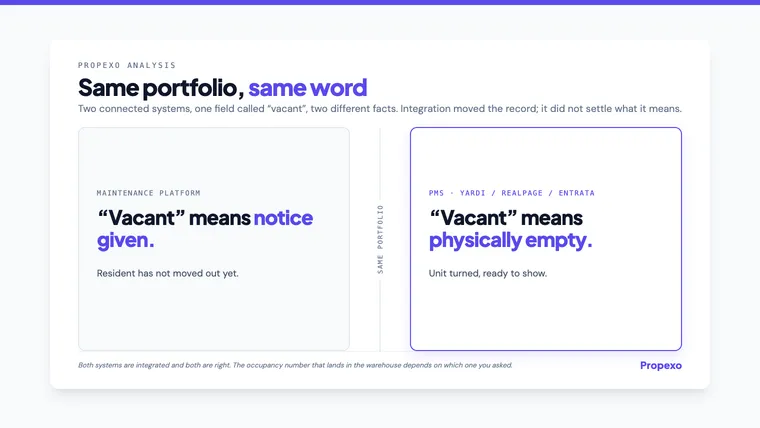
Because every operational tool in a multifamily stack keeps its own definitions, and nothing forces them to reconcile. A PMS, a maintenance platform, and a leasing CRM can each use the word “vacant” to mean something slightly different — pending move-out, notice given, or physically empty — and each one is internally consistent while disagreeing with the other two.
Stack a screening tool, an AI leasing assistant, and a resident engagement platform on top of that same PMS, and you don’t get a richer picture of a resident or a unit. You get several partial pictures, each accurate within its own tool and none of them reconciled with the others. That’s the fragmentation Thesis Driven’s piece names directly, and it’s the part that a faster API or a better export format doesn’t touch.
Why AI pilots are the moment this gap stops being theoretical
Because an AI tool doesn’t know its inputs are fragmented — it just answers anyway. Thesis Driven cites industry figures (MLQ’s research among them) putting AI pilot failure rates well above half, and separate research from JLL finding that most commercial real estate firms piloting AI hit only a fraction of their program goals. The pattern in both: the model wasn’t the constraint. The data feeding it was incomplete, and the tool produced a confident-sounding answer anyway.
That’s a worse failure mode than a broken dashboard, because a broken dashboard is obviously broken. A leasing recommendation or a maintenance-prioritization score built on a fragmented resident profile looks like a normal answer. It just isn’t reliably a correct one, and nothing in the AI layer will tell you that.
What a real data strategy actually requires
An operator-controlled data warehouse — Snowflake, Databricks, BigQuery, or similar — that you own regardless of which PMS or point tools you’re running this year or next. On top of that: automated pipelines that pull from every operational tool daily, not on whatever cadence the vendor’s report scheduler allows, feeding into one normalized schema where the same entity means the same thing everywhere it shows up.
That combination — owned warehouse, daily automated pipelines, one schema — is what turns “our systems are integrated” into “our data is usable.” Thesis Driven’s reporting names operators like AvalonBay and Bozzuto who built this layer deliberately, before layering AI on top rather than after discovering AI didn’t work without it. The order matters more than the tooling choice.
Where Propexo fits in that stack
Connect is the extract-and-load layer: it pulls raw data out of Yardi, RealPage, Entrata, AppFolio, and the rest of the multifamily PMS landscape and lands it in your warehouse, as-is. It does not transform or normalize anything in flight — that’s a deliberate boundary, because normalization decisions belong in a layer you can see and audit, not buried inside a connector.
That normalization happens in the Unified API, which sits on top of the raw, warehoused data and returns a consistent schema across every PMS it covers — so a query for “vacant units” behaves the same way whether the underlying system is Yardi or Entrata. Connect gets the data there without touching it; the Unified API is what makes it comparable once it has arrived. For a walkthrough of what that looks like across three systems at once, see building a single source of truth across Yardi, RealPage, and Entrata.
None of this requires waiting for a PMS vendor to open up further. The data your operational tools already produce is enough to build on, once it’s landed somewhere you control and structured one way instead of five.
Frequently asked questions
- Why do PMS integrations feel complete but analytics and AI projects still fail?
- Because integration and data strategy solve different problems. An integration moves data out of a system; a data strategy makes that data usable once it lands — normalized, deduplicated, and structured the same way regardless of which PMS or point tool it came from. Most multifamily operators have solved the first problem and never touched the second, which is why an AI tool or BI dashboard sitting on top of "connected" systems still returns unreliable answers.
- What are the main ways data gets out of a property management system?
- Four methods dominate: direct API calls, scheduled vendor reports, SFTP file drops, and read-only database access. All four are useful and all four are vendor-controlled — the vendor decides the schema, the refresh cadence, and (for database access) whether it is offered at all, often for a six-figure fee. None of them, alone, produces a dataset an analytics or AI team can build on without further work.
- Why do AI pilots fail on operational property data specifically?
- Because an AI tool inherits whatever structure its input data has. When a leasing CRM, a maintenance platform, and a PMS each define fields differently and none of them talk to a shared schema, an AI system layered on top does not get a unified resident or unit profile — it gets three partial ones. The tool still produces an answer; it just is not reliably a correct one, which is a harder failure mode to catch than a broken pipeline.
- What is the difference between Connect and the Unified API?
- Connect is extract-and-load: it pulls raw data out of Yardi, RealPage, Entrata, AppFolio, and other property management systems and lands it in your warehouse, unmodified. The Unified API is the normalization layer on top — it returns a consistent schema across those same systems, so "vacant" means the same thing whether the underlying record came from Yardi or Entrata. Connect gets the data there; the Unified API is what makes it comparable once it has arrived.
- What does an operator need in place before an AI project on portfolio data will work?
- An operator-controlled data warehouse, automated pipelines that refresh from every operational tool daily rather than on a vendor's schedule, and a normalized schema that resolves the same entity — a unit, a resident, a work order — the same way across every source system. Skipping straight to an AI pilot without this layer is why most of them stall: the model was never the constraint, the data underneath it was.
Written by
Remen Okoruwa
Co-Founder & CEO, Propexo
Remen is co-founder and CEO of Propexo. A former McKinsey consultant and HubSpot Senior PM, he is a Harvard graduate and has passed all three levels of the CFA exam. He writes about the data infrastructure layer multifamily operators need before analytics or AI projects can ship.
Keep reading
Property data integration
Your Market Data Is Unified. Your Operating Data Is Not.
A read of the 2026 CRE data-platform rankings: they rank the third-party market data you license and skip the first-party operating data you own.
8 min read
Property data integration
The PMS Data Egress Menu
PMS vendors are finally opening their data, and the hard part is shifting from access to choice
5 min read
Multifamily analytics & BI
The Biggest Operators Did Not Pick a PMS. They Picked a Warehouse.
Why portfolios above 15,000 units run several property management systems at once, and what that does to the question of which one to buy
6 min read