The Nearest Spreadsheet Is Your Real AI Policy
Your staff already use ChatGPT and Claude. The file they paste in is what the AI believes about your portfolio

Remen Okoruwa · Co-Founder & CEO, Propexo
One of our clients is a vertically integrated operator with a real warehouse. A report of theirs reached an investor with a figure in it that nobody could source.
When they traced it, the report had been written by an AI, from a spreadsheet somebody had exported and pasted into a chat window. Nobody had broken a rule. The model did what it was asked.
I’ve thought about that report every time I’ve heard a company announce an AI policy since.
The policy question is not which AI tool your staff may use. It is what the tool reads. Whatever the rules say, your people are already using ChatGPT and Claude, and the file they paste in has become the policy that holds.
Nobody is following the ban
The policy says no public AI tools, and the people with a deadline use them anyway.
In PagerDuty’s 2026 survey of 1,250 office professionals at companies with at least $500 million in revenue, two thirds of those who had used AI at work had done so while believing it was not permitted. More than a third had entered customer data into a public AI tool. Two years earlier, Microsoft and LinkedIn’s Work Trend Index found that 78 percent of the people using AI at work were bringing their own tools in.
Read those together and the ban is a fiction. What it changes is visibility: sanctioned use happens on a company account where somebody can see the prompts, and banned use happens on a phone.
Legal will tell you the ban was never meant to stop use. It’s there so that when a resident’s data turns up in somebody’s chat history, the company can point to a written rule and the person who broke it.
Keep the rule for that. It covers the afternoon something leaks, and does nothing for the ordinary afternoon, when nothing leaks and a stale number still reaches the renewal. The investor report had nobody to blame, because nobody broke the rule.
Stop counting who’s using it. Start counting what they’re feeding it.
The leak you fear is outbound. The damage is inbound.
Every AI policy I’ve read is written around the same fear: company data leaving the building. A rent roll pasted into a chat window, a lease uploaded to a free account.
That fear is reasonable. It’s also the half of the problem with a known fix, a contract that says no training and no retention. The other half has no clause.
The analyst who pastes the rent roll in wants an answer, and she’s going to use it. It goes into a renewal recommendation or a slide for the owner call. The data went out once, and what came back got a title and a date and started making decisions.
That investor report is what it looks like. Nobody was hurt by the leak. The answer did the damage.
The nearest spreadsheet wins
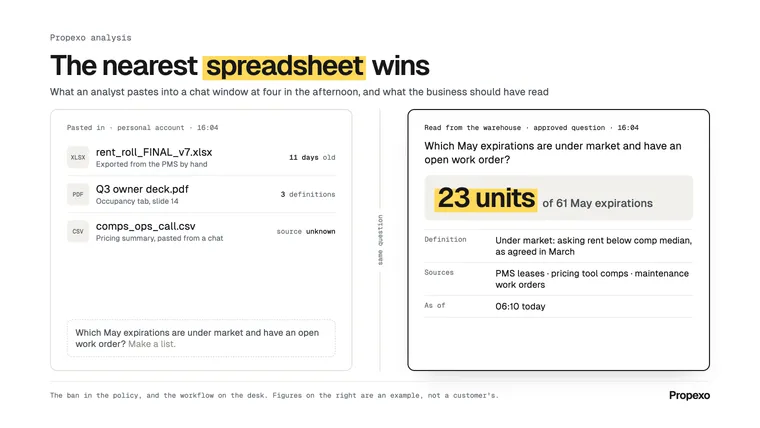
It’s four on a Friday afternoon. An analyst is at her desk, already half into the weekend, when the question comes down from the head of asset management: “Which of our May expirations are under market, and how many of those units have an open work order?”
The leases sit in the PMS and the comps in the pricing tool. The work orders live in a maintenance system that talks to neither, and asset management wants the answer before five.
So she grabs what’s nearest: a rent roll export from eleven days ago, with its own occupancy column, and the occupancy tab from the owner deck, which counts it differently. The pricing summary comes from the last ops call, built on the BI tool’s number. Nothing on her desk holds the work orders, so the model will do without them.
She pastes all of it into Claude and asks it to work out the list. Claude does. Fluently, in about eight seconds, with a confident paragraph on the end.
The occupancy tab is the quiet one. Her owner deck counts physical occupancy at month end, where the PMS export counts leased units today and the BI tool leaves down units out. All three are right by their own definition, and a model handed all three will pick one, or blend them, and report it with the same confidence either way.
A stale export pasted into a deck has been wrong for twenty years too. What AI removes is the person who would have paused at three occupancy numbers that didn’t match.
What that means in practice: the nearest spreadsheet just became the system of record for that decision, with nobody deciding it should be. The model can’t tell you the export is stale, or that the three occupancy figures were computed three ways.
It read what it was given and answered the question. That is the whole mechanism, and no policy about which tool she used touches it.
Go and look at what your team pastes in. Not the tool, the attachment.
She was right to paste it in
The question was a real one and the owner call was at five. The sanctioned route was a ticket to the BI team with a turnaround measured in days. Faced with days or eight seconds, she chose eight seconds. In her seat, so would I.
That’s the part most AI policies get backwards. They treat the person who found a faster route as the risk, when she’s the person telling you where the approved route is too slow. The ban punishes the workaround and leaves in place the reason for it: nobody can answer a cross-system question inside an afternoon without going around the systems.
Treat the shadow use as a map. Every attachment somebody pasted in marks a question the business asks and the stack can’t answer.
Sanctioning a tool changes nothing about the data
The standard fix is to buy the enterprise tier. ChatGPT Enterprise or the business version of Claude, with the no-training clause and the prompt logging your security team can sign off. Or a copilot inside each system.
That’s worth doing, and I’d do it. Then look at what it bought.
It changes where the prompt goes and nothing about what the prompt contains. The analyst on the enterprise account at four in the afternoon pastes in the same eleven-day-old export, because the enterprise account is no closer to the warehouse than the free one was.
Prompt logging is the tell. It shows you the question and not the eleven-day-old export the question was asked about, because the export never had a source to log in the first place.
The copilot inside the PMS is a cleaner version of the same limit. It’s fluent about the PMS, and the PMS holds one of the three answers the question needed. Unless every one of those systems comes from the same vendor, the copilot can see one of them, and the question that crosses systems is the question your business runs on.
Ask the vendor one thing before you sign: what does your tool read from, and who defined the numbers in it.
Make the right data the easiest data
The policy that works is a path, not a ban, and the path has to be faster than the export.
That means three things have to be true, and they’re all data work rather than AI work.
- Every system you run lands in a warehouse you own, so the three systems the question needed are in one place.
- The same resident, unit and vendor is recognized across all of them, and occupancy means one agreed thing, written once.
- The AI tool your team already has open can ask approved questions against that, read-only, and get the answer back with the definition and the source attached.
Do that and the four o’clock scene changes shape. The analyst types the question into the tool she was already using, and the answer comes back from the warehouse rather than from an attachment, with the definition it used and the time it read the systems underneath. This time the nearest spreadsheet loses, because the right data got there first.
Nothing about her changed: she’s still using Claude at four in the afternoon, and nobody filed a ticket. The only thing that moved is what the model read, and that’s the only thing that needed to.
This is what we build at Propexo. Connect lands every system you run in a warehouse you own, and Data Map holds the records and the definitions. Propexo MCP answers the approved questions inside the AI tool your team already runs.
Build the path with us or without us, but build it. The alternative is already running on your analysts’ phones.
Do this before your next AI policy review
- Find the attachments. Ask five of your heaviest AI users what they pasted into an AI tool last week. The files, not the tools. That list is your real AI policy.
- Pick the one question that crosses systems. The renewal question that needs the PMS and the maintenance log in the same answer. Make it answerable from one governed place before you buy anything else.
- Write your key metrics down once. And then get everyone to agree on the definitions. Keep them outside any vendor’s product.
- Give the sanctioned tool the right data. An enterprise account with nothing behind it is a quieter version of the ban. Point it at the warehouse, read-only, for the questions you approved.
- Time the two routes. If the governed answer takes longer than the export, the nearest spreadsheet wins again. Measure it.
Your best people have already decided they’re using AI. The only decision left for you is what it reads, and right now the nearest spreadsheet is making it for you.
Frequently asked questions
Should we ban ChatGPT and Claude at work?
A ban does not stop use. It moves use onto personal accounts and devices, where the company sees nothing and the data pasted in is whatever was nearest. The better policy names the tools that are allowed and puts the company's own governed data behind them, on a path quicker than an export. Staff who were going to use AI anyway then use it on the right numbers.
What is shadow AI?
Shadow AI is staff using AI tools the company has not sanctioned, usually a personal ChatGPT or Claude account, for work tasks: a rent roll export summarized before an owner call, or a lease pasted in to find a clause. It is the AI version of shadow IT. PagerDuty's 2026 survey found that two thirds of office professionals who had used AI at work had done so while believing it was not allowed.
What data is safe to use with AI tools at work?
Data that reaches the tool through a connection the company controls, and whose definition and source you can name. A figure from a governed warehouse, with the metric defined once and the system it came from attached, can be checked and traced. A spreadsheet export carries none of that: it is a snapshot of unknown age built on whichever definition the person exporting it chose. The safe data is the data with a trail.
How do we give staff AI access to company data without a leak?
Through a read-only connection to a warehouse you own, limited to questions you approved, with access running through the warehouse's own controls. The Model Context Protocol is the open standard for this, so any AI tool that supports it can read the same governed data. Nothing writes back to the property management system, and every answer carries its definition and its source.
Written by
Remen Okoruwa
Co-Founder & CEO, Propexo
Remen is co-founder and CEO of Propexo. A former McKinsey consultant and HubSpot Senior PM, he is a Harvard graduate and has passed all three levels of the CFA exam. He writes about the data infrastructure layer multifamily operators need before analytics or AI projects can ship.
Keep reading
AI readiness
Your Pipelines Are Landing Data. Your AI Still Can't Answer the Question.
Multifamily operators have solved data movement, not the layer above it. What matters now is a shared definition of what the data means.
AI readiness
Why Leasing AI Data Never Reaches Your Warehouse
A first-person account of where AI leasing conversation data lands, and why an API, a CSV export, and paid read access each stop short of solving it.
Property data integration
Your Market Data Is Unified. Your Operating Data Is Not.
A read of the 2026 CRE data-platform rankings: they rank the third-party market data you license and skip the first-party operating data you own.